The novelist Louise Erdrich has written a glowing review of Alan Weisman’s Countdown for her blog, Birchbark. She calls the book “urgent, eloquent, harrowing yet hopeful.”
Please read this book. Take your time. You will weep and yet be cheered.
The founder and owner of Birchbark Books in Minneapolis, Erdrich is a reader’s reader (she’s a writer’s reader, too!), and a passionate advocate for independent bookstores. Her latest novel, The Round House, won the 2012 National Book Award for fiction.
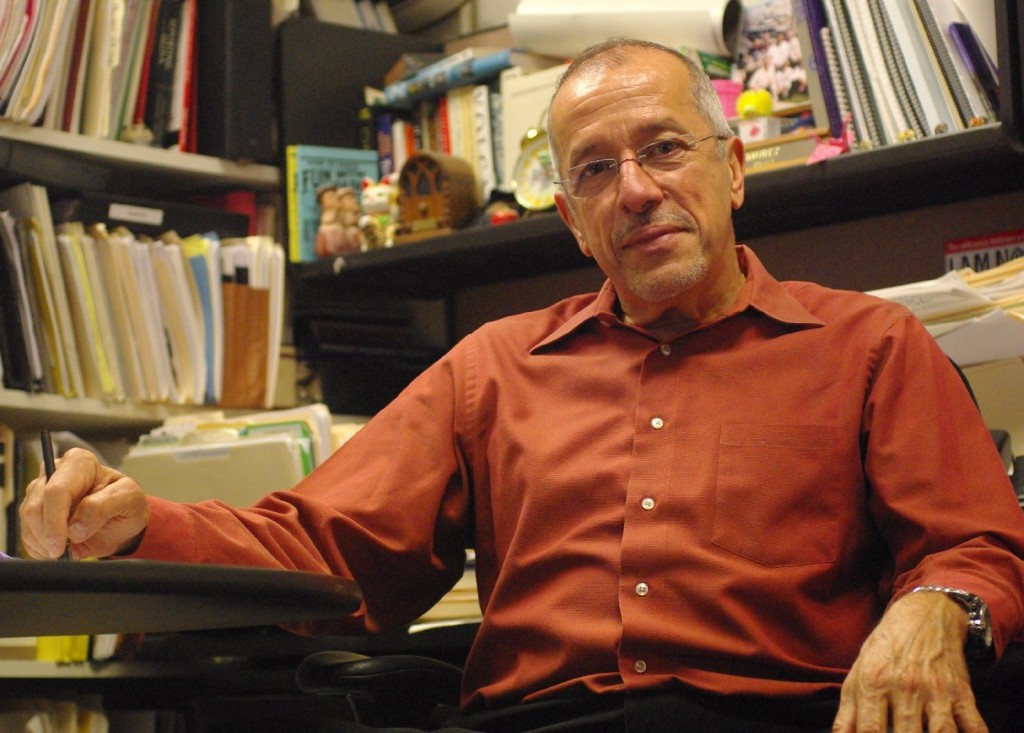
Raul Ramirez, longtime director of news and public affairs at KQED in San Francisco, died on November 15. A moving tribute can be found on the KQED website. Raul was also a dear friend of Homelands Productions and a member of our board.
I’ve never encountered a single person with such powerful currents flowing inside, in such abundance: humor, intelligence, kindness, awareness, curiosity, playfulness, personal bravery, professional courage, generosity, grace, decency, consideration, passion, panache, good will, a commitment to justice, an unending humanity, and a profound capacity for loving life. I’m sure I’ve missed something.
Seeing Raul always made me happy. I loved my occasional stays with him and his husband Tony on my jaunts north from LA. With those visits I understood the tremendous range of his intellectual and artistic curiosity, which sank in deeper each time, in part by my perusing his eclectic and fascinating bookshelves. His generosity on those visits was intrinsic to Raul – like when he went so far as to encourage my roars for my beloved Green Bay Packers from his couch. (“Oh, my, Mr. Tolan,” Raul declared one evening after I leapt off said couch upon the completion of a short pass in the first quarter. “I had no idea.”) Of course, that was vintage Raul, and I’ve seen it so many other times: his gift, in friendship, in professional settings too, for making people feel so comfortable.
In January 1992, I was in Washington for interviews with government officials and scientists at the nearby Goddard Space Center for a story that would be the finale of our original Homelands namesake series, “Vanishing Homelands.” It was a program about the ozone hole, set in southern Chile and Antarctica. I had reported it with our colleague Cecilia Vaisman, but I would be handling these last interviews alone, because she had been recruited that month to produce a special public radio series set in south Florida’s Cuban community with a renowned journalist who’d grown up there, Raul Ramirez. Raul was a veteran print reporter, but this would be his first foray into documentary broadcast. Cecilia, an NPR producer before joining Homelands, would be his co-reporter and radio mentor – as, for the previous year-and-a-half, she had been mine.
When I arrived, Raul and Cecilia were also in Washington, where their reporting would be edited, mixed, and produced. Among the many things that struck me upon hearing of their experiences was how Raul had managed to apply the discipline of journalism to a story that impacted him so personally and profoundly. His allegiance to his community was matched by his obligation to his audience. He became an inspiring example to me of how a great journalist blends uncompromising professional rigor with compassion for his subjects to produce the unforgettable kind of reporting we all hope to achieve.
In the years that followed, when I’d be invited to KQED to appear on public affairs programs about my books, Raul and I would have long lunches to talk shop and life. At times when I was struggling with subjects I was trying to cover, I was hugely grateful for Raul’s encouragement, judgment, and perspective. When he joined the board of Homelands Productions, not only did we all benefit from his concern and wisdom, but we were honored to be able to call Raul Ramirez our colleague. He always will be. I hear him still, urging me on. Mil gracias, hermano.
We at Homelands are mourning the loss, on the morning of November 15, of our dear friend, colleague, fellow Homelands board member, and trailblazing journalist, Raul Ramirez.
Raul Ramirez, 1946-2013. Photo: Ian Hill/KQED.
Accolades about Raul have been coming in for weeks, ever since his countless friends learned that he was suffering from esophageal cancer, and that he probably wouldn’t make it.
KQED’s obituary, and the comments that follow it, hint not only at the outpouring of love for this remarkable man, but at his inspirational reach, through his teaching, mentoring, leadership, and the standard of unsurpassed integrity that he established.
Here’s one example, from the obituary by David Weir and Patricia Yollin:
In May 1976, after months of investigation, Ramirez and freelance journalist Lowell Bergman broke a story for the Examiner about a Chinatown gang murder case titled “How Lies Sent Youth to Prison for Murder.” The article detailed how an assistant district attorney and two police inspectors had pressured witnesses into lying, resulting in the conviction of Richard Lee. The three law enforcement officers sued the Examiner, Bergman and Ramirez for libel, seeking $30 million in damages.
When the Examiner, then owned by the Hearst Corp., refused to provide counsel for the freelancer Bergman, leaving him without representation, Ramirez as a matter of principle and conscience refused to be represented by the Examiner’s lawyer and joined with Bergman to seek outside counsel. A group of journalists and lawyers rallied around the two reporters and raised enough money to hire a lawyer and fight the case. Though they initially lost in Superior Court and were ordered to pay $4.56 million in damages, Bergman and Ramirez spent the next decade fighting the verdict. Ultimately, the libel ruling was overturned by the California Supreme Court in 1986. The following year, the U.S. Supreme Court refused to hear an appeal of that decision, ending the matter once and for all.
Raul Ramirez was a magnificent human being. His way of living in the world remains an inspiration. We will miss you terribly, dear Raul, but we will go on living with you within us. That will always be a gift, and a comfort, and a way of grounding us in the direction of the kind, the humane, the brave, the curious, the decent, and the fun.
***
Raul’s family has asked that donations in his memory be made to The Raul Ramirez Diversity in Journalism Fund at San Francisco State University.
Checks should be made out to The San Francisco State University Foundation with a notation that the donation is for “The Raul Ramirez Diversity in Journalism Fund.” Please mail to: Office of University Development, ATTN: Andrea Rouah, San Francisco State University, 1600 Holloway Ave., ADM 153, San Francisco, CA 94132.
To donate online, go to www.sfsu.edu/~develop/makeagift.htm. Select “Other” from the drop-down menu of “I Would Like to Support” and, in the text box “If Other, Enter Designation,” type “The Raul Ramirez Diversity in Journalism Fund.”
We’re thrilled to announce the publication of Countdown: Our Last, Best Hope for a Future on Earth?, by Homelands senior producer and co-founder Alan Weisman. You should be able to find it in bookshops today, and if you pre-ordered it from an online seller, it should be on its way.
Every four and a half days, the world population goes up by another million. Photo by Sam Eaton.
Published by Little, Brown and Co., Countdown is Alan’s sixth book and a fitting sequel to his international bestseller, The World Without Us. In the earlier book, he looked at how the natural world might heal if freed from human pressure. In Countdown, he asks how we can bend our population curve to avoid a collision with the planet’s resource base.
If The World Without Us was a grand thought experiment, Countdown is an urgent – and practical – call to action.
Check out the book’s trailer (yes, it has a trailer!) here. Read an excerpt in Salon here. And see what the reviewers are saying here. Then go out and get a copy!
A listener contacted us after our story aired on PRI’s The World about entrepreneur Charles Mulamata’s effort to start an aquaponics business in his native Uganda. (Aquaponics is a combination of fish and vegetable farming that promoters say is more efficient and productive than conventional methods.) Geoff Platt, who develops aquaponics systems in Arizona, asked us to forward his contact information to Mulamata. Here’s what he wrote today:
Does good journalism change anything? Can words make an impact? Through this interview you may well have started something much larger than you could have imagined….
I am currently helping [Charles] develop several businesses. A mobile aquaponics van, a vertical farming system capable of much larger yields, a wood gas stove designed to reduce eye problems related to smoke exposure, and a bamboo farm to provide cheap, renewable wood to burn as well as continue to build the bicycles they make out of bamboo.
Charles Mulamata hopes to build an aquaponics facility on this plot near Kampala. Photo by Jon Miller.
He goes on to report that Mulamata, an engineer who has started several small businesses, has petitioned the Ugandan government for access to land on an island in the Nile to start an aquaponics research facility and tilapia nursery.
We have no idea how this will all turn out, but it’s great to be reminded that a six-minute radio story can catalyze real action on the other side of the world. We’ll keep you posted as things develop.
“Spirited descriptions, a firm grasp of complex material, and a bomb defuser’s steady precision make for a riveting read…. Weisman’s cogent and forthright global inquiry, a major work, delineates how education, women’s equality, and family planning can curb poverty, thirst, hunger, and environmental destruction. Rigorous and provoking.” —Donna Seaman, Booklist (starred review)
“In Countdown, Alan Weisman, a journalist probing whether a sustainable balance between nature and the human population can be achieved, offers a key message to guide future action.” —Nature
“This is not a jeremiad but a realistic, vividly detailed exploration of the greatest problem facing our species.” —Kirkus Reviews (starred review)
“Provocative and sobering, this vividly reported book raises profound concerns about our future.” —Publishers Weekly (starred review)
“Countdownis [Weisman’s] bold, troubling, and often inspiring search for ways to save ourselves.” —Men’s Journal
Here’s the press release from the publisher, Little, Brown and Company:
Alan Weisman’s previous book, “The World Without Us,” was a finalist for the National Book Critics Circle Award. It has been translated into 34 languages.
In his internationally bestselling book The World Without Us, Alan Weisman considered how the world could heal and even refill empty niches if relieved of humanity’s constant pressures. Behind that groundbreaking thought experiment was his hope that we would be inspired to find a way to add humans back to this vision of a restored, healthy planet—only in harmony, not mortal combat, with the rest of nature.
But with a million more of us approximately every 4 1/2 days on a planet that’s not getting any bigger, and with our exhaust overheating the atmosphere and altering the chemistry of our oceans, prospects for a sustainable future seem ever more in doubt. In Countdown: Our Last, Best Hope for a Future on Earth?, Alan Weisman’s long awaited follow-up book, he traveled to 21 countries to ask four questions that experts agreed were probably the most important on Earth—and also the hardest.
How many people can the Earth sustain?
If, in order to ensure our survival, we need to stop our growth before we hit 10 billion—or even reduce our numbers from our current 7 billion—is there an acceptable, nonviolent way to convince all of the world’s cultures, religions, nationalities, tribes, and political systems that it’s in their best interest to do so?
What kind of ecosystem is necessary to maintain human life, and what species or ecological processes are essential to our survival?
If a sustainable population on Earth is less than our current growth projection, or even less than our current number, how do we design an economy for a shrinking population, and then for a stable one—that is, for an economy not dependent on constant growth?
Truly a journalistic tour de force, Countdownis a riveting piece of narrative nonfiction that is impossible to put down, as compellingly entertaining to read as its message is urgent.
Weisman takes readers around the world to such diverse locales as Pakistan, a land the size of Texas whose numbers by midcentury will surpass today’s United States; the Philippines, where too many fishermen struggle to feed large families from increasingly depleted seas whose rising waters encroach on cropland; to Niger, with the world’s highest fertility rate, where each woman bears an average of seven to eight children; to Italy and Japan, where population has actually fallen below replacement rate: two children per two adults.
Weisman shares alarming projections about our ability to keep feeding growing multitudes, but he also reveals some startling successes, such as in Iran, where a voluntary family planning program dropped the highest rate of population growth in history to replacement level a year faster than China’s compulsory one-child policy.
By vividly detailing the burgeoning effects of our cumulative presence, Countdownreveals what may be the fastest, most acceptable, practical, technologically feasible, and affordable way of returning our planet and our presence on it to balance. Alan Weisman again shows that he is one of the most provocative journalists working today, with a book whose message is so compelling that it will change how we see our lives and our destiny.
The stories cited by the SEJ deal with the Fukushima disaster and the global threats of climate change. All were broadcast on PRI’s The World and were edited by Peter Thomson. Peter also edited the “What’s for Lunch” series of “Food for 9 Billion.”
In addition to producing the television features, our friends at CIR created an animated video called “The Hidden Costs of Hamburgers,” which has been viewed more than 184,000 times.
And of course all the partners blogged and tweeted as we went.
The project isn’t actually 100 percent finished. We’re still working on educational materials for high school students, and CIR plans to produce a long-form television feature about the food relationship between the US and China. We’ll keep you posted on those. We’ll also keep the Twitter account alive, at least for a while.
We love collaborating with other people, projects, and organizations. We also serve as fiscal sponsor for projects that align with our mission. If you’d like to explore how we might work together, send us a note at info@homelands.org.
Our work would be impossible without the generosity of supporters who share our commitment to high-quality public-interest journalism. Please donate online or visit our support page for more options.