One of the perpetual challenges for any journalist is to figure out when a person or fact or event is somehow representative of some larger reality, and when the personality or information or situation is so specific that it only really tells us about itself. It’s a constant question when my colleagues and I go out into the world to do radio stories about workers and their jobs.

We’re trying to help our listeners understand what life is like for people to whom they may be connected but are unlikely to meet in person. And we’re trying to build a portfolio that, taken as a whole, reflects the richness and complexity of the world as it really is. But we’re also looking for good stories, with tension and conflict and drama – stories that will draw our listeners in, and make them care and remember.

Let’s say we want to profile an oil worker, or a miner, or a mail carrier, or a sex worker. Should we look for someone who is typical? Or someone who is remarkable? Or someone who is typical but especially articulate, or whose life is especially dramatic, or whose situation illustrates a point we want to make?

I did a profile of my Peruvian friend Marco, who had worked in textile factories since he was a teenager. Now he was trying to start his own business. I was there for the opening of his little factory, then followed up a year later to see how he did. It made sense thematically – Marco was a minor player in a huge global industry. And although his story wasn’t exactly action movie material, it had its dramatic elements – a main character who was trying to accomplish something, who faced serious obstacles, and whose situation developed over time. Because I knew him, I had a level of access I might not have gotten with a stranger. I think the story “worked.”

But if we’re producing a series about work in the global economy, and we’re going to do just one piece about a textile worker, is Marco really the person we should feature? Wouldn’t it be better to find, say, a female sewing machine operator trapped in a sweatshop somewhere? Marco was ambitious and highly skilled. He had three brothers who more or less shared his dream. He had an intelligent, strong-willed wife who was determined to rise above her own peasant origins. He had an aunt who was willing to give up the first floor of her house. He had cancer, which gave him a heightened sense of urgency. Every one of those details mattered. I wouldn’t say Marco was remarkable, really, but he wasn’t typical either. Should we have chosen someone else?

On the same visit to Peru I traveled to La Oroya, a town in the high Andes that is dominated by a giant smelter. La Oroya is one of the most polluted places on earth; in some neighborhoods, more than 90 percent of the children suffer from lead poisoning. But jobs at the smelter pay well and are highly coveted. I decided to look for someone who could shed light on the trade-off that so many workers face, not just in La Oroya but around the world, between a steady paycheck and personal hardship. I’m an experienced reporter, and it seemed like a clear enough brief.

There was, I soon discovered, a complicated back story. The U.S. company that owned the smelter only bought it ten years before, and much of the contamination was caused by earlier owners. There had been significant improvements, and more were promised. The great majority of townspeople were fiercely defensive of the plant. In fact, the day I arrived, an angry mob tried to throw government safety inspectors into the river. But activists insisted that the company wasn’t doing nearly enough. The government, too, was losing patience.

If I had been doing a standard feature story, it would have been fairly easy to present all this information and take a stab at sorting it out. But we were doing profiles, and our topic was work. I needed to find someone who worked at the smelter and who struggled to balance, every day, the benefits with the risks.

The company provided me with workers to interview; not surprisingly, they thought things were pretty peachy. Union leaders weren’t eager to help – they were more concerned that nosy journalists and government do-gooders might shut the plant down. Few of the smelter workers lived in the affected neighborhoods anyway. Those were populated by the poor and the unemployed.

It took me four days to find a man who worked at the plant, who lived very close, who was suffering from a serious lung ailment, and who was willing to speak up about it. His story was true, and it was dramatic, and it spoke to the larger issue of trade-offs that we were determined to address. But Pedro Córdoba wasn’t typical, at least for that town. I tried to make that clear in my radio piece, but the fact remains that the only metal worker in our series is a man whose situation and attitude were different than those of most of his coworkers. Was profiling him a responsible choice?

It’s not an easy question to answer. Certainly it would be irresponsible if all the workers in our series were dying of incurable diseases or toiling in subhuman conditions (or, for that matter, finding personal fulfillment). But it would be just as irresponsible to choose all our subjects for what they represent rather than for who they are. Because the fact is no one is typical. And that may be the most powerful point we can make in this series. The woman on sewing machine 7, row 15, is a different person from the woman on sewing machine 11, row 9. People aren’t types. Personalities matter. Circumstances matter. Details matter. For as literature shows us again and again, it’s only when we understand the particulars that the general becomes, well, true.

Jonathan
A quick note about some good work that has grown out of reporting for the WORKING project. Kelly McEvers has written a multipart series in Slate about her adventures finding and profiling a pirate in Indonesia. Today (12/4) Kelly hosted a live chat on washingtonpost.com about her experiences reporting her profile of Agus Laodi.

Gregory Warner produced a creepy/funny piece for This American Life’s annual “Poultry Slam” show, reported while he was in Quetta, Pakistan, looking for a human smuggler to profile. Gregory will also produce a short version of his recent profile of Fidele Musafiri, Congolese miner, for the international blog site Global Voices.

Last year I wrote a piece for FRONTLINE/World based on my reporting in La Oroya, Peru, where I went to profile a metal worker at the giant smelter there.

Jon

One rap against cool web-based media applications is that they attract a disproportionate number of males and a disproportionate number of people who work in information technology. I just sorted the early discoverers of the Worker Browser tonight and found that we have 180 males and 19 females. We’ve hardly publicized the thing at all – these are almost all folks who have discovered it on their own. But it’ll clearly be a challenge as we move forward to reach out to women and to people who don’t spend their days online. Not that I have anything against males or cyberpersons!

While we’re talking demographics, since I reported on where folks are coming from, we’ve had participants from Brazil, Germany, Greece, New Zealand, Norway, the Philippines, and Romania. That makes workers from 29 countries and at least 37 states. Which is just so cool.

Jon

Folks, please check out Gregory Warner’s profile of Fidele Musafiri, a coltan and cassiterite (tin) miner in the eastern Democratic Republic of Congo. It’s tragic and powerful and pretty much exactly what we were aiming for when we cooked up the WORKING project. You can hear it at our WORKING Flash site – click on the Radio Stories tab (or the LISTEN button) and it’s the first one. Please also read the reporter’s notebook and look at Thomas Rippe’s superb photos. My hat is off to Gregory and Thomas – this was an extremely hard story to do, physically and emotionally.

The mine where Fidele works has been in the news lately, as fighting has broken out again between military factions and anti-government rebels. As if the people there haven’t suffered enough. Lydia Polgreen wrote a major spread for the New York Times on November 16. She was in the area just before our guys were there. Chilling.

Jon

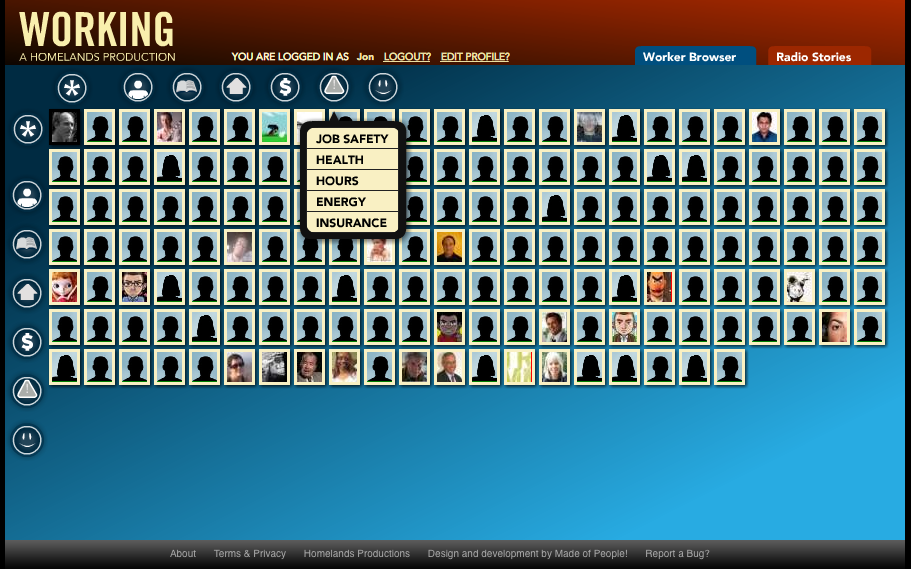
What a thrill to go online today and see that 164 people had put their profiles up on the Worker Browser! Up from just 15 yesterday. We’ve barely mentioned it to anyone, but apparently folks are finding out. Fantastic to see the entries of working people in Spain, Malta, Lithuania, China, Canada, Italy, UK, Bahrain, Indonesia, Turkey, India, Saudi Arabia, Sweden, Mozambique, Australia, Malaysia, Japan, Serbia, Hong Kong, as well as many states in the USA. Lots of people who work online, but also factory workers, cashiers, teachers, technicians, students, librarians, and engineers. Every time I checked during the day another person or two had joined the mix.

Here’s a picture from 11 pm on 11/16:

worker-browser1

I notice that very few have filled out the text boxes elaborating on their answers, and even fewer have answered the questions at the end (dream job, what I like about my job, what I don’t like about my job, how I define “decent work”). I hope people will go back and fill those in — for me, the explanations are the most interesting part!

If you visit the browser and fill out the questionnaire, please let us know how it went. We know there are bugs and we’d love to get ’em fixed before the big rush comes.

Jon

I hope you got to hear the latest WORKING profile. It was produced by Kelly McEvers and features a pirate, Agus Laodi, in Indonesia. Agus boards cargo ships in the Strait of Malacca, holds their crews at knifepoint, and steals the money from their safes. Then he spends his “earnings” on women and booze instead of sending them home to his family. He is not, I’d venture to say, a terribly admirable fellow.

I think it’s a fascinating, revealing piece of journalism. It’s timely (pirates have been much in the news lately) and it has everything to do with the global economy (cargo ships move 90 percent of all traded goods, and piracy remains one of their biggest challenges). It is also an intimate look into the life of a person who has chosen a path and who doesn’t seem capable of changing course. Kelly observes (keenly) but she doesn’t judge. The feedback so far has been very good. But some listeners have written to say that it was wrong to feature a criminal, or to call him a “worker.”

This is the second WORKING profile of a person whose work is illegal (the other was a prostitute in Azerbaijan). One of the first pieces in the series features a fixer in Lebanon who turns out to be a bit of a shady character; a more recent profile features a trader in Dubai who sometimes smuggles American goods into Iran despite a US trade embargo. (Hmm, all four of these have been reported by Kelly – what is it about that woman?) An upcoming piece, produced by Gregory Warner, profiles a human smuggler on the Pakistan-Afghanistan border.

I have been in favor of including all sorts of workers in our series, law-abiding or not. Illegal work (from trafficking in drugs, arms, wildlife, and human beings to extortion, insider trading, and email fraud) is a significant part of the global economy. For some people it’s the only employment available; others see it as the only way to get ahead. I figure an honest group portrait of the working world has to include some folks operating on the dark side. I’m curious what others think. Are we glorifying scoundrels by giving them their eight minutes of fame?

Jon

P.S. We are saddened by the passing of Studs Terkel, but joyful in the knowledge that he touched so many people over his long life, and that his good work will live on. Studs was convinced that everyone has a story to tell – that simple, subversive idea has been a major inspiration for our work.

I know if you’re reading this you’re a true fan. So I’d like to invite you to check out something we’ve been quietly developing for two years as part of the WORKING project. It’s called the Worker Browser, and according to our propaganda (which I wrote and therefore must live with) it “allows working people around the world to share and compare their work experiences.”

Which is true! Anyone with access to a computer can fill out a simple questionnaire and upload it to a database that can be manipulated in all sorts of intellectually and aesthetically pleasing ways. The topics are both objective (income, education, commute, etc.) and subjective (satisfaction, security, dream job). If you don’t want to add your profile to the mix, that’s fine; you can just explore what other people have posted. (I’ve never been able to describe it — if you go there and poke around I promise it will make sense!)

We’ve also begun uploading all the audio, photos, and reporters’ notebooks from the radio profiles that are airing every month on Marketplace. So theoretically you could spend hours there.

The url is http://working.homelands.org. It’s still in “beta” — we’ve been madly testing and editing it for the last few weeks (especially the last few days), and there’s still work to do. But it basically works, and we’re ready to start “populating” it with real people rather than fake Latin placeholders. Please do take a look and, if you’re brave enough, upload your own profile. And let us know what you think! We’ve never done anything remotely like this before.

The Worker Browser is designed by Thiago Demello Bueno of Made of People!, with lots of input from Sue Johnson, Matt Shultz, and yours truly. We’re excited to be working with the Global Affairs Club of the School of Industrial and Labor Relations (ILR School) at Cornell University — they’re basically in charge of spreading the word. But don’t hesitate to do that, too.

Jon

P.S. Just learned that Kelly McEvers’ profile of Agus, an Indonesian pirate, has been rescheduled for October 30. It’s worth the wait.

The Third Coast Festival has come and gone. What an amazing community we indie producers have managed to create! Two and a half days of hugs, grins, coffee, wine, and dancing. Oh, and networking, workshopping, CD-swapping, and technical talk. (There was a touch of the Titanic about it, with news of failing banks and free-falling financial markets burbling quietly in the background.)

On Saturday afternoon the fabulous Kitchen Sisters (a.k.a. Davia Nelson and Nikki Silva) presented their “favorite things” to an exhausted and admiring crowd; somehow they coaxed all 400 of us to stand up and join in rousing renditions of Sixteen Tons and A Little Help from My Friends. That night Homelands’ pal Chris Brookes was named this year’s “Audio Luminary” (that’s the festival’s lifetime achievement award) — if you’ve never heard his work PLEASE check him out. A good place to start is an award-winning piece he did as part of our Worlds of Difference series called A Map of the Sea.

Sandy, Cecilia, and I snuck away from time to time to talk about our next project. We’d like to do a multimedia series on hunger. As with WORKING, we’ll want to focus on individual human beings. It’s a timely topic, sad to say: the number of hungry people around the world is now more than 900 million, and rising. With the economic mess, water shortages, food and fuel price volatility, rising populations, and climate change, things are unlikely to improve in the near term. If you have thoughts about the topic, or if you have ideas on who might support the project, please let us know!

Jon

P.S. Next up on WORKING is Kelly McEvers’ profile of a pirate who robs ships in Indonesia’s Strait of Malacca. If you want a reminder, go to our website and sign up for our mailing list.