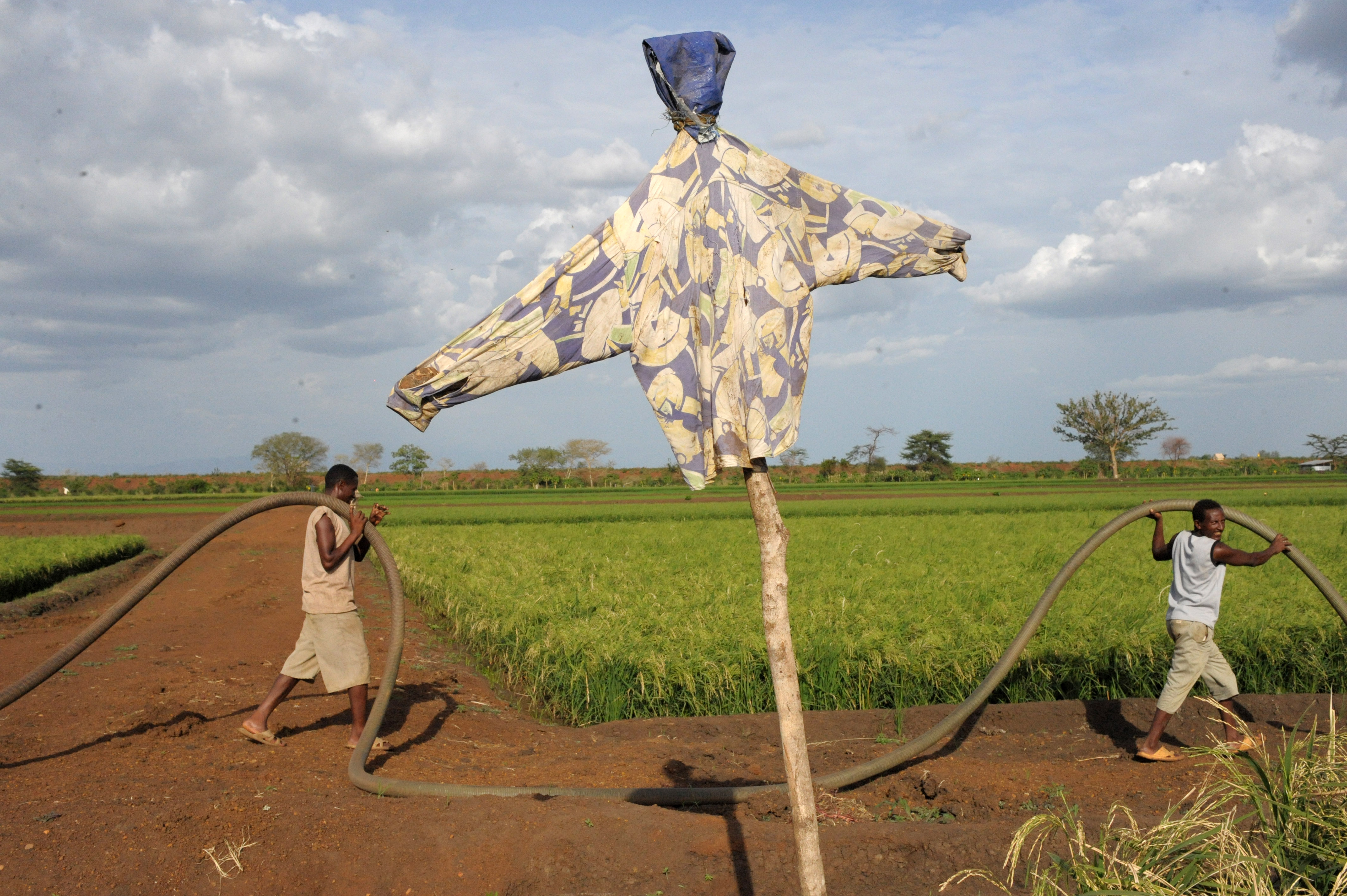
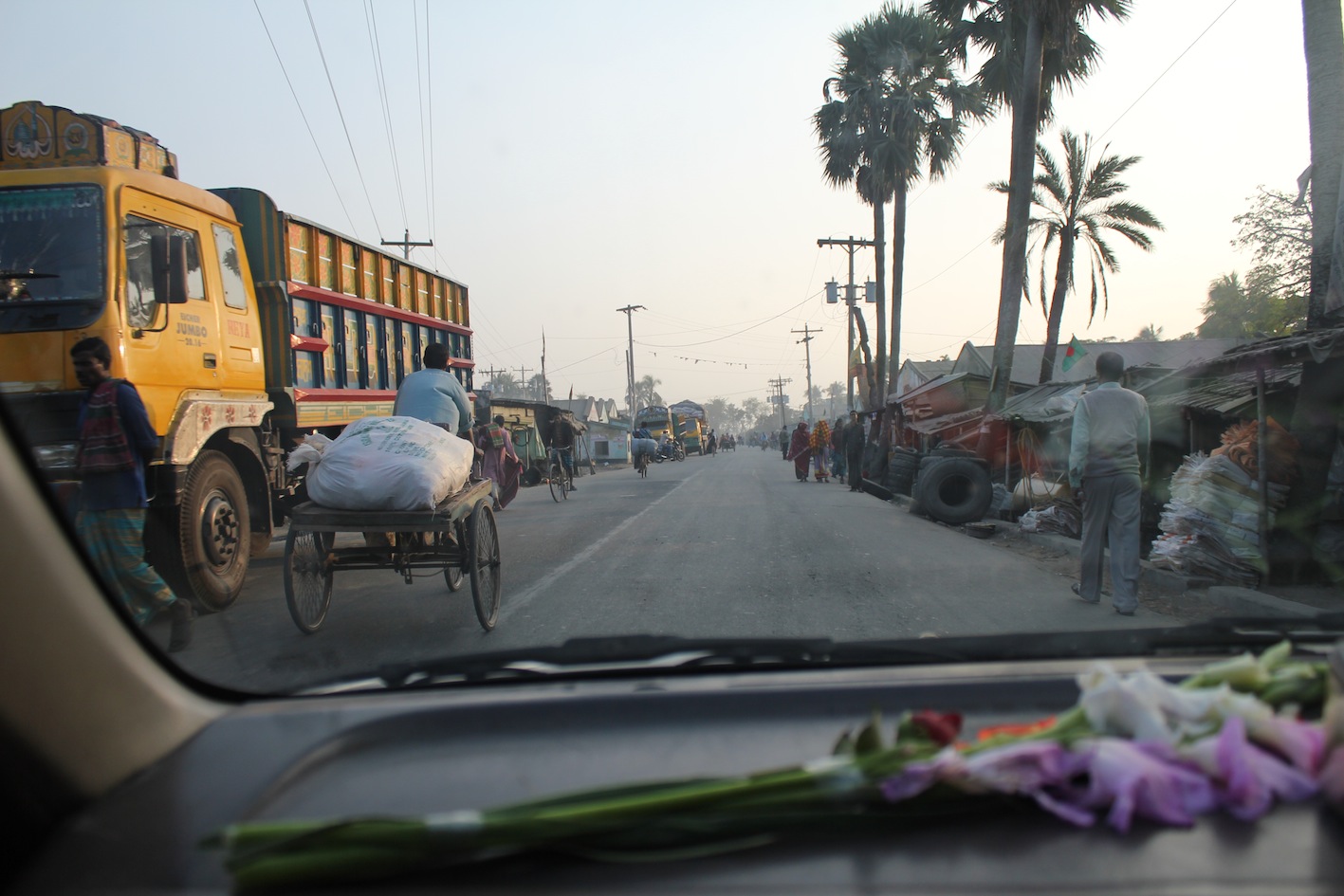
We wanted to catch you up on the “Food for 9 Billion” project, which has been taking most of our attention lately. As loyal readers will know, Ff9B asks what has to happen for the world to be able to feed itself sustainably and equitably over the next three decades. It’s a collaboration among Homelands Productions, the Center for Investigative Reporting (CIR), American Public Media’s Marketplace and PBS NewsHour.
So far we’ve produced nine radio features, six video features and three features especially for the web. Our reporting has taken us to Mexico, Egypt, the Philippines, Bangladesh, Ethiopia, Kenya, Rwanda, Brazil, India, Ghana, Japan, Niger and Vietnam. Upcoming stories are from Senegal, China, Lesotho, Zambia, Greece, Brazil and the United States.
You can listen to the radio stories, watch the TV stories, and fiddle around with the web features at the project’s home page on the CIR website. And if that’s not enough links for you, please also check out the “Food for 9 Billion” blog and follow the project on Twitter.
Americans love burgers. They’re filling, tasty and cheap. But what we pay at the counter is only part of the story. Check out this animated video from the “Food for 9 Billion” project, a collaboration between Homelands Productions and the Center for Investigative Reporting (CIR). CIR’s Carrie Ching directed and produced; art and animation is by Arthur Jones.
The video launched with the new I Files investigative video channel on YouTube, which is programmed by CIR. You can find a fully annotated version here.
Today’s news from the Supreme Court brought back memories of a story I reported in 2006 for a BBC series on juvenile justice around the world. I traveled to Colorado to meet with young men serving life without parole for crimes they had committed when they were teenagers. I also met with families, prosecutors, officials, and activists. It was an emotional, enlightening, and enraging trip, and I think the story, which runs nearly 22 minutes, was as good as anything I’ve been involved in.
The piece was produced and narrated by Vera Frankl, a longtime Homelands friend and collaborator. The audio is still online – please click on the link above if you’re interested. Hundreds of people are in prison around the country for crimes they committed as juveniles; some did not engage in violence but were accessories to violent crimes committed by others.
Rajendra Singh is known as “The Water Man” for his work on community-based water management in India. Photo: Jon Miller/Homelands Productions.
It’s been more than a month since I posted anything on the Homelands blog! Too busy producing and planning “Food for 9 Billion” stories. Yesterday, a feature I reported in India aired on Marketplace. It profiles Rajendra Singh, a charismatic leader in India’s grassroots rainwater harvesting movement. You can read a blog post I wrote about the story’s take-home message. (A hint: it’s less about rainwater harvesting than about the tremendous promise of bottom-up approaches to water management.)
On April 4, Marketplace broadcast a piece by Homelands co-founder Cecilia Vaisman about Brazil’s “Zero Hunger” program. Brazil has declared food a basic human right; “Zero Hunger” is the government’s attempt to deliver on its pledge to make sure that everyone has enough. The story shows how hard that is in practice. Idealistic planners originally saw the program as a way to spur rural development by linking small-scale farmers to poor consumers; over time it has become much more about direct cash payments using tax money generated by agribusiness.
In her story, Cecilia asks what other countries can learn from the Brazil experience, noting that “Zero Hunger’s” longtime director, Jose Graziano da Silva, is now head of the Food & Agriculture Organization of the UN. Her answer is that it’s not enough to declare food a right, nor to expect hunger to disappear as an economy grows. It takes a society-wide commitment, and many boots on the ground.
I want to take a minute to welcome Ceci back to radio land. This piece was the first story she has produced for national broadcast since 2003. We missed her voice. It’s a joy to have her on the air again.
Congratulations to our friends at the Center for Investigative Reporting (CIR), who just announced their merger with the Bay Citizen. According to CIR, the merger “will create the largest nonprofit organization in the country focused on watchdog and accountability journalism.” You can read about the merger on the CIR blog and on the Bay Citizen site.
The Saudi-owned company Saudi Star plans to create Africa’s largest rice farm in Ethiopia and export the rice to the Middle East. Photo: Dallas McNamara
In recent months, both Human Rights Watch and the Oakland Institute have released reports critical of the Ethiopian government’s “villagization” program, which moves isolated farm families into permanent settlements.
The Human Rights Watch report documents the removal of tens of thousands of members of the minority Anuak tribe from their farms in the Gambella region. It includes satellite maps showing patterns of displacement.
Both organizations have questioned whether donor money is facilitating the forced relocation of Ethiopian farmers. Ethiopia receives more than $1 billion a year in US aid. The Ethiopian government denies that the villagization program is connected to its policy of leasing prime farmland to foreign corporations.
I hope you get to listen to the latest “Food for 9 Billion” piece on Marketplace today, about Bangladesh’s attempts to cope with climate change. It shows how, in the absence of major funding from greenhouse gas-emitting nations, the government, NGOs, scientists, communities, and farmers are scrambling to adapt to a new climate reality. You can see a slideshow on the Marketplace story page.
Muhammad Sekendar Ali on his farm on Gabura Island in southern Bangladesh. Photo: Jon Miller
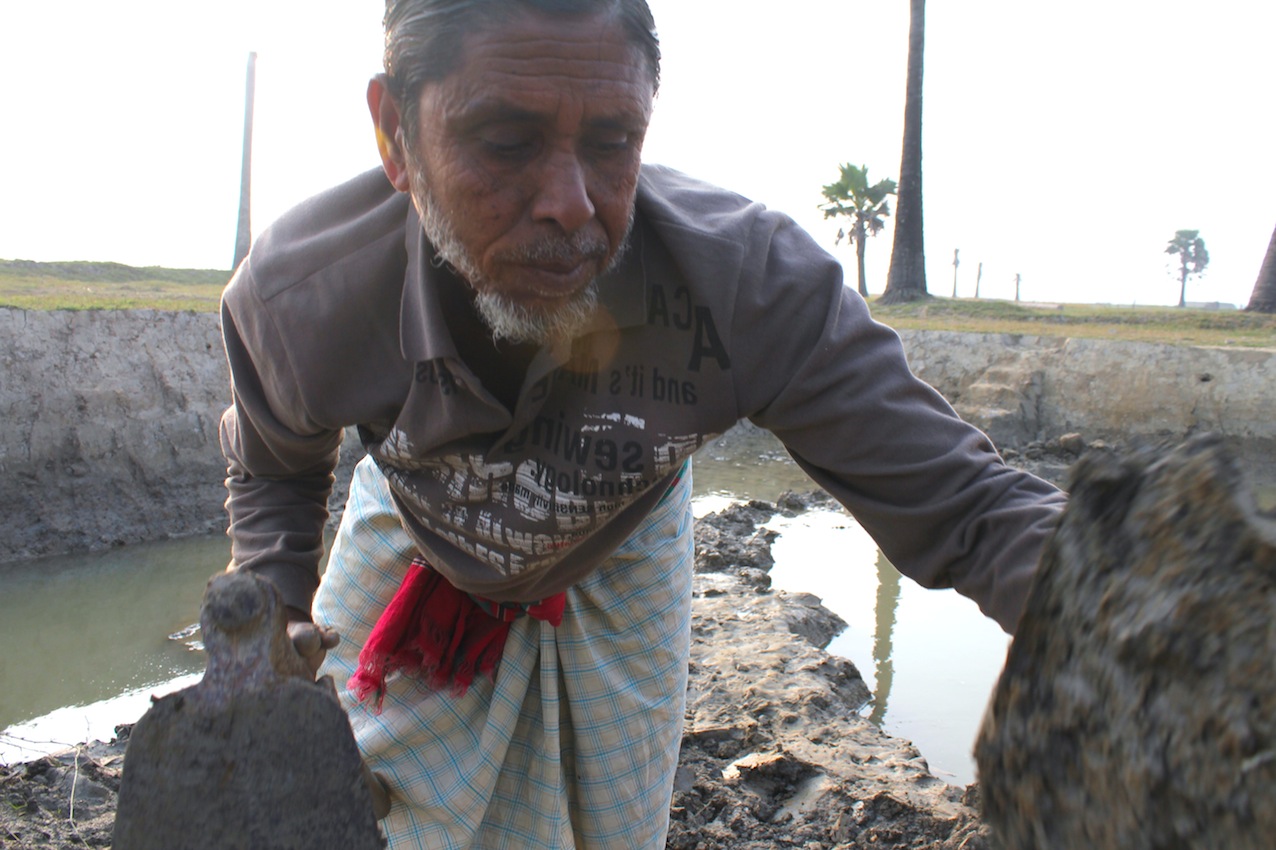
Early in the story I visit a 62-year-old man named Muhammad Sekendar Ali. He’s a rice farmer on an island in the Bay of Bengal whose one-room shack was destroyed by a storm six months earlier. The whole area was flooded by seawater (he showed me the high water mark halfway up a palm tree); with nowhere to live and no way to make a living, he fled with his family to the mainland, where he and his sons found occasional work as laborers.
When I met him he had recently returned to the island to try to begin farming again, but the soil was still too salty. So he and his son, Salauddin, were expanding the earthen platform they had built to elevate their new house. It was a job made for a wheelbarrow, but they didn’t have one, so they carried wedges of mud in bowls on their heads. In that vast landscape of devastation, their effort seemed somehow heroic. But there was little reason to believe that they would be any more prepared for the next storm than they were for the last one.
At the risk of stating the obvious: Poverty makes people vulnerable to climate calamities, and climate calamities make it extremely difficult for people to get out of poverty. This is true for families and communities, and it’s also true for countries.
I lived in the Philippines for eight years and had the chance to experience the terrifying power of more typhoons and tropical storms than I care to remember. Luckily for me, I got to watch them from a sturdy concrete house with a well-attached roof and a backup electrical system. After the storms would pass, I’d turn on the radio and hear about the dozens or hundreds or thousands of people who had lost their lives in floods or mudslides or capsized ferries.
Which brings me back to Bangladesh. It’s flat and wet and prone to flooding. It has 500 miles of coastline and sits on a major cyclone path (cyclones, hurricanes and typhoons are all the same thing). Because the land is made mainly of silt from the Ganges, Brahmaputra and Meghna river systems, there are virtually no stones with which to build levees, seawalls or dikes. In a world of rising sea levels, stronger storms, melting glaciers, and increasingly erratic rainfall, Bangladesh is a disaster waiting to happen. Or, as I found during my visit, a disaster that’s already happening.
If the sea level rises one meter by 2100, more than 15 million Bangladeshis may be displaced. Photo: Jon Miller
But what puts Bangladesh so high on the lists of vulnerable countries is not geography, but economics and demographics. More than half the population (an astounding 160 million, squeezed into a land area the size of Iowa) is involved in agriculture or fishing. There has been impressive economic growth in recent years (Bangladesh has become the world’s leading exporter of ready-made garments), but one in three Bangladeshis still lives on less than $1.25 per day. All of which means that the weather is a matter of life or death for an enormous number of people, most of whom produce food for a living, and this puts the entire population at risk.
I don’t want to downplay the physical dangers of climate change in Bangladesh or other front-line countries. They are deadly serious, and require action. But the dangers of poverty may be even more urgent.
One last thing. In my story I say that many of the people I met in Bangladesh were pessimistic about the country’s ability to stay ahead of climate change. Their pessimism may be justified. But it’s worth noting how effective Bangladesh has been at facing other challenges. My last visit was 20 years ago, shortly after a cyclone killed 138,000 people. Since then, the country has built thousands of cyclone shelters (including one about a hundred yards from Muhammad Sekendar Ali’s house) and established a nationwide early warning system that relies on community participation. In 2007, a cyclone almost identical in size and strength to the 1991 storm took fewer than 3,000 lives. Still a horrible toll, but an unmistakable sign of progress. And achieved, by rich-country standards, on a shoestring.
We love collaborating with other people, projects, and organizations. We also serve as fiscal sponsor for projects that align with our mission. If you’d like to explore how we might work together, send us a note at info@homelands.org.
Our work would be impossible without the generosity of supporters who share our commitment to high-quality public-interest journalism. Please donate online or visit our support page for more options.